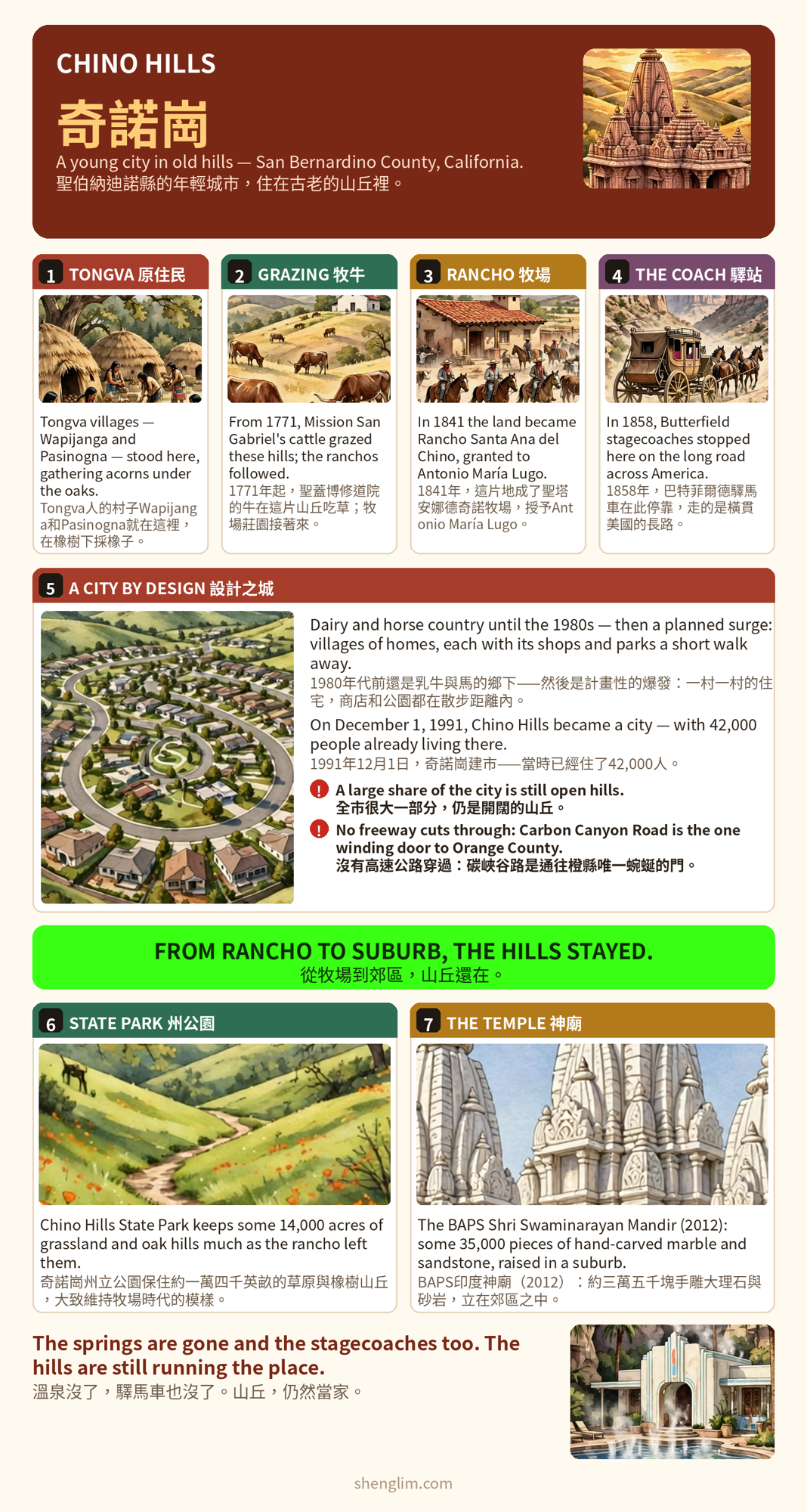
Union City was two old towns that voted to become one. Chino Hills is the opposite story: a city drawn on a map in 1991, on ranch land so old that the cattle trails came first — and the hills never left.
聯合市是兩座老鎮投票合成一座。奇諾崗剛好相反:1991年才在地圖上畫出來的城市,蓋在老牧場地上——牛走的路比人還早到,而山丘,從來沒離開過。
Rancho Land
牧場年代
The Tongva had villages here — Wapijanga and Pasinogna — gathering acorns under the oaks long before any border was drawn.
Tongva人早就在這裡有村子——Wapijanga和Pasinogna——在橡樹下採橡子,遠在任何邊界被畫出來之前。
After Mission San Gabriel was founded in 1771, mission cattle grazed the hills. In 1841 the land became Rancho Santa Ana del Chino, a Mexican grant to Antonio María Lugo; five years later the Battle of Chino was fought here during the Mexican-American War.
1771年聖蓋博修道院成立後,修道院的牛在山丘上吃草。1841年,這片地成為聖塔安娜德奇諾牧場,是墨西哥授予Antonio María Lugo的土地;五年後,美墨戰爭的奇諾之役就在這裡打響。
Gold made Northern California rich; beef made this corner rich. In 1858 Chino Hills was a stop on the Butterfield Overland Mail stagecoach line, and in 1881 the rancho was sold to Richard Gird, who went on to found the town of Chino next door.
黃金讓北加州致富;牛肉讓這個角落致富。1858年,奇諾崗是巴特菲爾德陸上郵驛馬車線的一站;1881年,牧場賣給了Richard Gird,他後來創建了隔壁的奇諾市。
Springs, Bootleggers and Hippies
溫泉、私酒與嬉皮
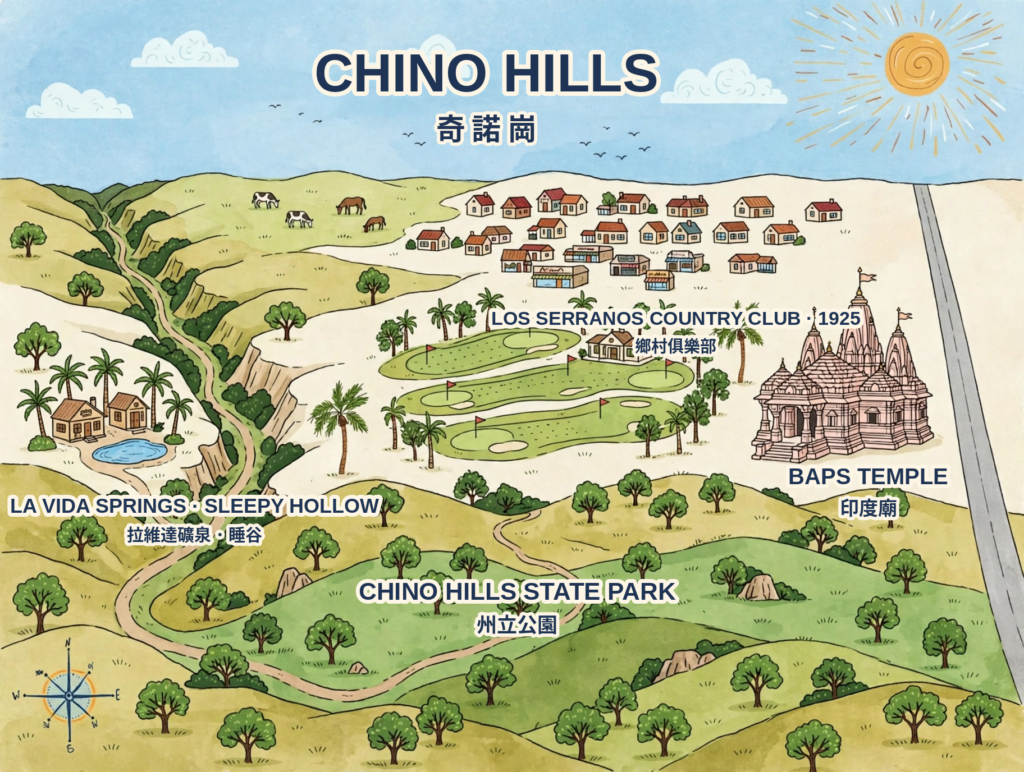
In Carbon Canyon, the La Vida Mineral Springs drew Los Angeles tourists to take the waters — and, in Prohibition days, the same isolation drew bootleggers. A mineral spring is a fine front for a still.
在碳峽谷,拉維達礦泉吸引洛杉磯遊客來泡湯——而在禁酒年代,同樣的偏僻也引來了私酒販。礦泉,是蒸餾器最好的掩護。
The Los Serranos Country Club opened in 1925, and the canyon neighborhood of Sleepy Hollow kept its sleepy name honestly: in the 1960s it became a small colony of hippies and artists, hiding in the hills.
洛斯塞拉諾斯鄉村俱樂部1925年開幕,峽谷裡的社區「睡谷」名副其實:1960年代,它成了嬉皮和藝術家藏在山裡的小殖民地。
Otherwise, well into the 1970s, this was still horse and dairy country — 45 square miles of rolling grass at the meeting point of four counties.
除此之外,一直到1970年代,這裡都還是馬和乳牛的鄉下——45平方英里的起伏草原,位在四個縣的交界。
A City by Design
設計出來的城市
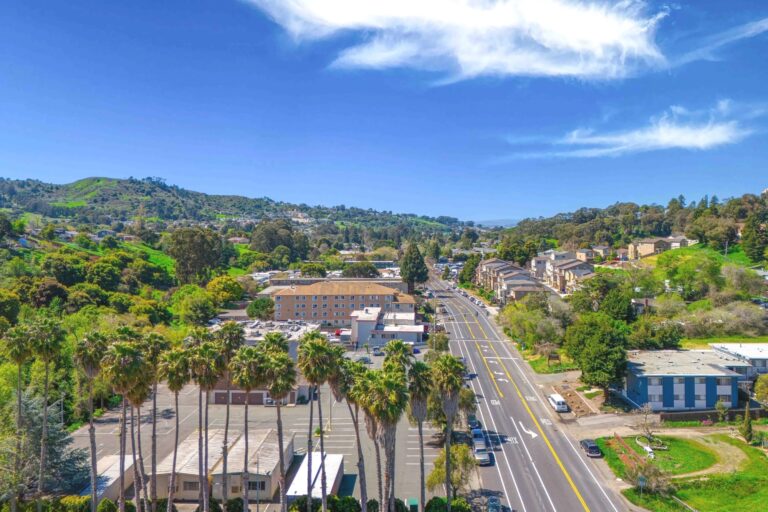
The growth, when it came, was planned: in the 1980s, developers laid out villages of homes in the hills, each with its own shopping center and parks within walking distance.
成長來臨時,是計畫好的:1980年代,開發商在山丘間鋪開一村一村的住宅,每一村都有自己的購物中心和公園,走路就到。
On December 1, 1991, Chino Hills incorporated — a brand-new city that already had 42,000 residents. No old downtown, no founding families with streets named for them; the master plan was the founding document.
1991年12月1日,奇諾崗建市——一座全新的城市,卻已經有42,000名居民。沒有老市中心,沒有以創始人命名的街道;總體規劃,就是它的建國文件。
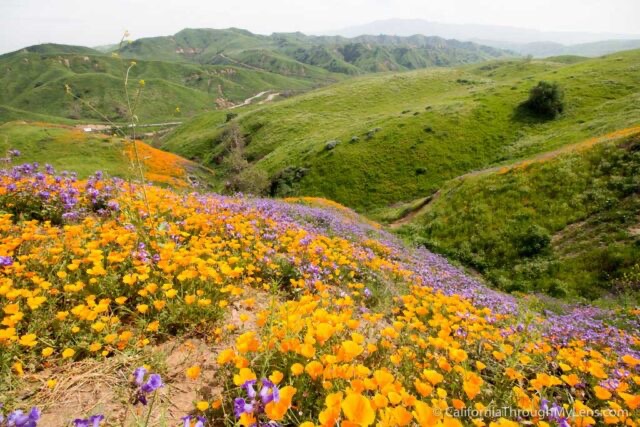
And the plan kept the hills: Chino Hills State Park, created in 1984, holds about 14,000 acres of grassland and oak woodland along the city’s western edge, so a third of the view from any ridge is still ranch country.
而規劃保住了山丘:1984年成立的奇諾崗州立公園,在城市西緣保住約一萬四千英畝的草原和橡樹林,所以站在任何山脊上,三分之一的視野仍是牧野。
The City Today
今日奇諾崗
The 2020 census counted 78,411 people. About a third — 34% — were born in another country, and nearly half the homes speak a language other than English at the kitchen table.
2020年普查數到78,411人。約三分之一——34%——出生在另一個國家;將近一半的家庭,在餐桌上說著英語以外的語言。
Here is everyone, counted once — the Census counts Hispanic or Latino as its own group, so nobody is counted twice.
這是每一個人,只算一次——普查把拉丁裔獨立成一組,所以沒有人被算兩次。
| Group | People | Share |
|---|---|---|
| Asian | 31,417 | 40.1% |
| Hispanic or Latino | 22,084 | 28.2% |
| White | 18,465 | 23.5% |
| Black | 3,116 | 4.0% |
| Two or More Races | 2,701 | 3.4% |
| Native American, Pacific Islander & Other | 628 | 0.8% |
| Total | 78,411 | 100% |
The city’s landmark is not a city hall but a temple: the BAPS Shri Swaminarayan Mandir, opened in 2012, built from some 35,000 pieces of hand-carved Italian marble and Indian sandstone — arguably the most beautiful building in the Inland Empire, sitting in a suburb.
這座城市的地標不是市政廳,而是一座神廟:BAPS印度神廟,2012年啟用,用約三萬五千塊手雕的義大利大理石和印度砂岩建成——可以說是內陸帝國最美的建築,就坐落在郊區裡。
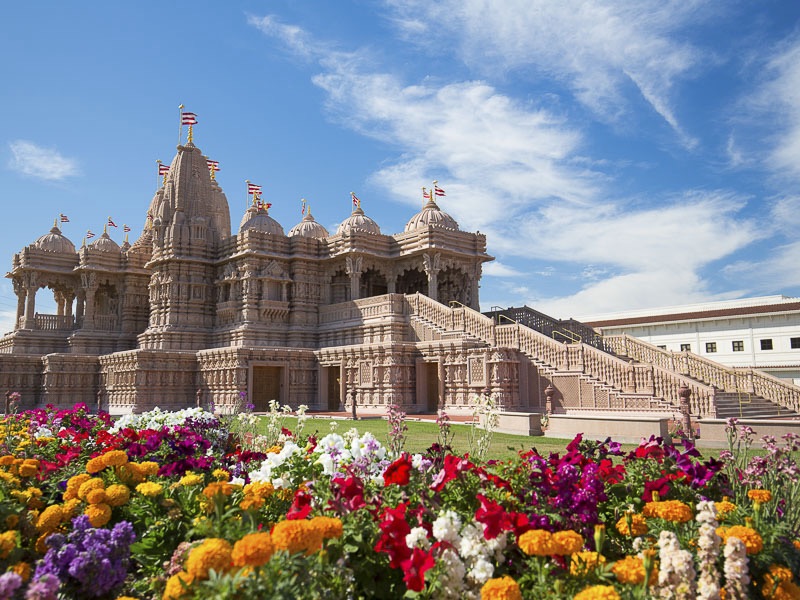
The temple deserves a slower look. It is a BAPS mandir — BAPS is short for the Bochasanwasi Akshar Purushottam Swaminarayan Sanstha, a Hindu fellowship — consecrated on December 23, 2012, as only the fifth traditional stone mandir in North America, on a 20-acre site.
這座廟值得慢慢看。它是BAPS的神廟——BAPS是Bochasanwasi Akshar Purushottam Swaminarayan Sanstha的簡稱,一個印度教團體——2012年12月23日祝聖啟用,是北美第五座傳統石造神廟,佔地20英畝。
Some 1,500 artisans carved its 35,000 pieces in India — Italian Carrara marble and Indian pink sandstone, 122 pillars and 6,600 carved motifs, with no iron or steel in the stonework — then shipped them across the ocean to be assembled here like a giant jigsaw puzzle, following India’s ancient architecture texts, the Shilpa Shastras.
約一千五百位工匠在印度雕好它的35,000塊石件——義大利卡拉拉大理石與印度粉紅砂岩,122根柱子、6,600個雕刻紋樣,石造部分不含鋼鐵——再越洋運來,在這裡像巨型拼圖般組裝起來,遵循印度古老的建築典籍《Shilpa Shastras》。
Underneath sit 40 base isolators that let the whole temple float up to four feet during an earthquake — the first earthquake-proof mandir in the world, built to last a thousand years. Reading that, the next paragraph may not surprise you.
廟底裝了40個隔震器,地震時整座廟能漂移達四英尺——全世界第一座防震神廟,目標屹立一千年。讀到這裡,下一段你可能就不會驚訝了。
Who is worshipped inside? At the center is Bhagwan Swaminarayan (1781–1830), whom BAPS followers believe is not a prophet or a saint, but God himself — Purushottam, the supreme being, who took human form on earth. Beside him stands Gunatitanand Swami, honored as Akshar: God’s eternal abode and his perfect devotee, who comes to earth in every age as the living guru. Worshipping the two together is the heart of the faith — it is even in the organization’s name: Akshar Purushottam.
廟裡拜的是誰?正中央是Bhagwan Swaminarayan(1781–1830),BAPS信徒相信他不是先知、也不是聖人,而是神本身——Purushottam,至高的存在,以人的形體來到世間。他身旁站著Gunatitanand Swami,被尊為Akshar:神永恆的居所與祂最完美的奉獻者,在每個時代以活著的上師之姿來到人間。兩位一起敬拜,是這個信仰的核心——甚至就在這個組織的名字裡:Akshar Purushottam。
The teaching, in one breath: reality holds five eternal things — the soul, great souls, maya (the illusion that keeps souls attached and reborn), Akshar, and God. Freedom — moksha — comes when the soul, guided by the living guru, becomes like Akshar and serves God forever in his abode, Akshardham. That is why the sacred images (murtis) in the shrines are treated as living residents, not decorations: after consecration, God is believed to truly dwell in them. They are awakened each morning, dressed, offered food, and put to rest at night, with five prayer ceremonies — arti — a day.
這個教義,一句話說完:世界有五樣永恆之物——靈魂、大靈魂、瑪雅(讓靈魂執著、不斷輪迴的幻象)、Akshar,和神。解脫——moksha——是靈魂在活著的上師引導下,變得像Akshar一樣,永遠在神的居所Akshardham侍奉祂。所以神龕裡的聖像(murti)被當作活著的住客,不是裝飾:經過祝聖之後,信徒相信神真的住在裡面。每天清晨喚醒、更衣、獻食,夜裡安歇,一天五次祈禱儀式——arti。
Visitors of any faith are welcome — shoes off at the stairs, shoulders and knees covered, and no photographs inside. The photo rule is almost a gift: the carved ceilings reward eyes, not cameras.
任何信仰的訪客都歡迎——上階梯前脫鞋,遮住肩膀和膝蓋,廟內不可拍照。不可拍照這條規矩幾乎是份禮物:雕花的天花板,是賞給眼睛的,不是給相機的。
In 2008 the ground reminded everyone it is awake: a magnitude 5.4 earthquake, centered here, was felt from San Diego to Las Vegas. The hills, as always, had the last word.
2008年,大地提醒大家它醒著:一場5.4級地震,震央就在這裡,從聖地牙哥到拉斯維加斯都有感。山丘,一如既往,有最後發言權。
Good to Know
造訪筆記
“Chino” is Spanish for “curly” — the name is said to describe the curly hair of a local chief the Spanish met. A whole city, named for a haircut.
「Chino」在西班牙語是「捲的」——據說是西班牙人遇見的當地酋長一頭捲髮。一整座城市,以髮型命名。
There is exactly one road from Chino Hills into Orange County: Carbon Canyon Road (SR-142), two lanes, winding, and occasionally closed by landslides. Plan accordingly.
從奇諾崗進橙縣只有一條路:碳峽谷路(142號州道),雙線、蜿蜒,偶爾還因山崩封閉。請提早打算。
City facts: 44.7 square miles; median household income around $122,600 (2023 estimate); schools are a major reason families move here. The Shoppes at Chino Hills is the main outdoor mall.
城市小檔案:44.7平方英里;家庭所得中位數約122,600美元(2023年估計);學區是許多家庭搬來的主因。主要戶外購物中心是The Shoppes at Chino Hills。
Let’s Talk About It
來聊一聊
Kevin: “So you live in Chino Hills? Isn’t that, like, brand new?”
凱文:「所以你住奇諾崗?那不是,像,全新的地方嗎?」
Rosa: “The city is. The hills aren’t. My street is younger than I am.”
羅莎:「城市是新的,山丘不是。我家那條街,比我還年輕。」
Kevin: “What’s it like, living in a master plan?”
凱文:「住在總體規劃裡,是什麼感覺?」
Rosa: “Everything’s a ten-minute walk — school, park, boba. Even the temple.”
羅莎:「什麼都在步行十分鐘內——學校、公園、珍珠奶茶。連神廟都是。」
Kevin: “The Hindu temple? I’ve seen photos. It’s unreal.”
凱文:「那座印度神廟?我看過照片,美得不像真的。」
Rosa: “Thirty-five thousand carved stones. People drive from everywhere to see it.”
羅莎:「三萬五千塊雕刻的石頭。人們從各地開車來看。」
Kevin: “And when you want to leave?”
凱文:「那你想離開的時候呢?」
Rosa: “One road to Orange County. One. You learn to check the traffic before you commit.”
羅莎:「去橙縣只有一條路。一條。你會學會先看路況再出門。」
Kevin: “Sounds peaceful, though.”
凱文:「不過聽起來很安靜。」
Rosa: “It is. Coyotes in the canyon, quakes now and then — the hills remind you who’s boss.”
羅莎:「是啊。峽谷裡有郊狼,偶爾震一下——山丘會提醒你誰當家。」