Every quarter, two envelopes compete for my attention: the custodian’s statement and my advisor’s report. The statement is the receipt; the report is the story. Here is how I read the story — in the order the money moves.
每季有兩個信封搶我的注意力:保管機構的對帳單,和顧問的報告。對帳單是收據;報告是故事。這是我讀故事的方法——照著錢移動的順序讀。

The First Number
第一個數字
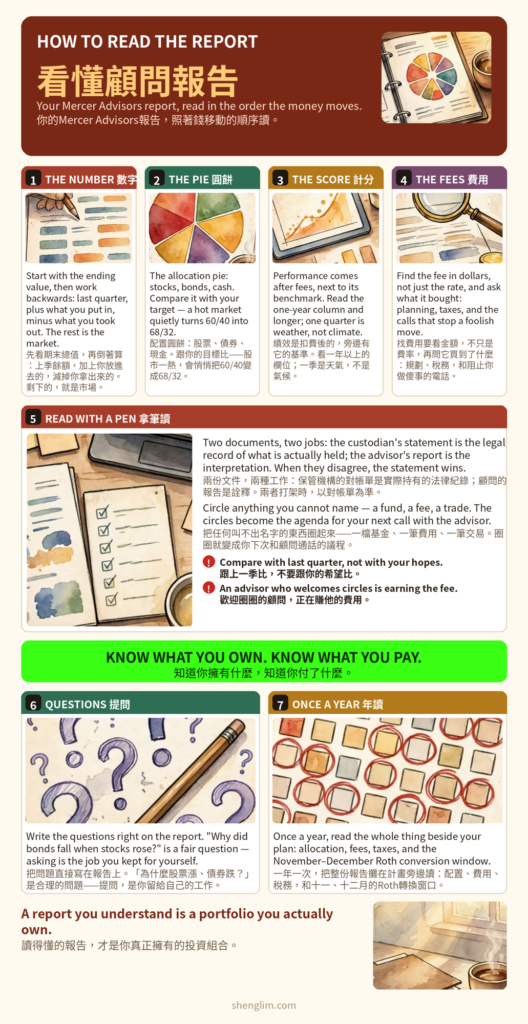
I start with the ending value: what the portfolio is worth today. Then I work backwards — last quarter’s ending value, plus what I put in, minus what I took out. Whatever is left is what the market did. If those four numbers don’t tell a clean story, nothing after them will.
我先看期末總值:這個投資組合今天值多少。然後倒著算——上季的期末值,加上我放進去的,減掉我拿出來的。剩下的,就是市場做的。如果這四個數字說不出一個乾淨的故事,後面的都不用看了。
This is also where I separate my behavior from the market’s. A quarter where I withdrew money for taxes is not a bad quarter; it is a planned one.
這裡也是我把「我的行為」和「市場的表現」分開的地方。為了繳稅而提款的那一季,不是壞的一季;那是計畫中的一季。
The Pie
圓餅圖
Next, the allocation pie: how much sits in stocks, bonds, and cash. I compare it with the target my plan set — say 60/40 — not to the decimal, but for drift. A hot stock market quietly turns 60/40 into 68/32, and the pie is where you catch it.
接著看配置圓餅:多少在股票、多少在債券、多少是現金。我拿它跟計畫定的目標比——比方60/40——不用比到小數點,比的是漂移。股市一熱,會悄悄把60/40變成68/32,圓餅就是抓到它的地方。
Drift is not a sin; it is a reminder. Rebalancing is the boring machine that sells high and buys low without asking my feelings.
漂移不是罪,是提醒。再平衡是那台無聊的機器,不問我的感受,自動賣高買低。
The Scoreboard
計分板
Then performance — the number everyone flips to first and understands last. Mercer reports it after fees, against a benchmark built to match the portfolio. I look at the one-year and longer columns, and mostly ignore the quarter: one season is weather, not climate.
再來是績效——每個人第一個翻到、最後一個看懂的數字。Mercer報告的是扣費後的績效,旁邊放著一個跟投資組合匹配的基準。我看一年和更長的欄位,基本上忽略單季:一季是天氣,不是氣候。
And a warning I give myself: my return and the portfolio’s return are two different animals when money moves in and out. The report’s number is the portfolio’s; my life runs on the other one.
也提醒自己一句:當錢進進出出時,我的報酬和投資組合的報酬是兩種動物。報告上的數字是投資組合的;我的日子靠的是另一種。
The Fees
費用
Advisors are paid from the account, usually a percentage of assets, billed quarterly. I find the fee in dollars, not just the rate, and I do one rude piece of math: the dollars per year, and what they bought — planning, taxes, conversions, and the phone calls that stop me from doing something foolish.
顧問費從帳戶裡扣,通常是資產的百分比,按季收費。我找的是金額,不只是費率,然後做一道無禮的算術:一年多少美元,買到了什麼——規劃、稅務、轉換,和那幾通阻止我做傻事的電話。
Fees you can see are fees you can judge. If I cannot find the dollars in the report, that itself is the finding — and my first question at the next meeting.
看得見的費用,才評得了。如果我在報告裡找不到金額,那本身就是發現——而且是我下次開會的第一個問題。
Good to Know
看報告筆記
Two documents, two jobs: the custodian’s statement is the legal record of what is actually held; the advisor’s report is an interpretation. When they disagree, the statement wins.
兩份文件,兩種工作:保管機構的對帳單是實際持有的法律紀錄;顧問的報告是詮釋。兩者打架時,以對帳單為準。
Read with a pen. I circle anything I cannot name — a fund, a fee, a trade — and the circles become the agenda for our next call. An advisor who welcomes circles is earning the fee in that moment.
拿著筆讀。我把任何叫不出名字的東西圈起來——一檔基金、一筆費用、一筆交易——圈圈就變成下次通話的議程。歡迎圈圈的顧問,那一刻就在賺他的費用。
Once a year I read the whole report beside the plan: allocation, fees, taxes, and the Roth conversion window in November and December. Quarterly is a glance; yearly is a decision.
一年一次,我把整份報告攤在計畫旁邊讀:配置、費用、稅務,還有十一、十二月的Roth轉換窗口。季讀是掃一眼;年讀是做決定。
Let’s Talk About It
來聊一聊
Paul: “Do you actually read those quarterly reports from your advisor?”
保羅:「你真的會看顧問寄來的季報嗎?」
Karen: “Cover to cover? No way. I read three pages.”
凱倫:「從頭看到尾?不可能。我只看三頁。」
Paul: “Which three?”
保羅:「哪三頁?」
Karen: “The pie chart, the scoreboard, and the fees. If those three look right, the rest is details.”
凱倫:「圓餅圖、計分板、費用。這三樣沒問題,剩下的都是細節。」
Paul: “And if they don’t?”
保羅:「如果有問題呢?」
Karen: “I circle it in red and bring it to the call. That’s what I’m paying for — answers.”
凱倫:「我用紅筆圈起來,帶去通話裡問。我付的錢,買的就是答案。」
Paul: “My guy hates questions.”
保羅:「我的顧問討厭被問。」
Karen: “Then, my friend, you don’t have an advisor. You have a subscription.”
凱倫:「那,朋友,你那不叫顧問。那叫訂閱。」