
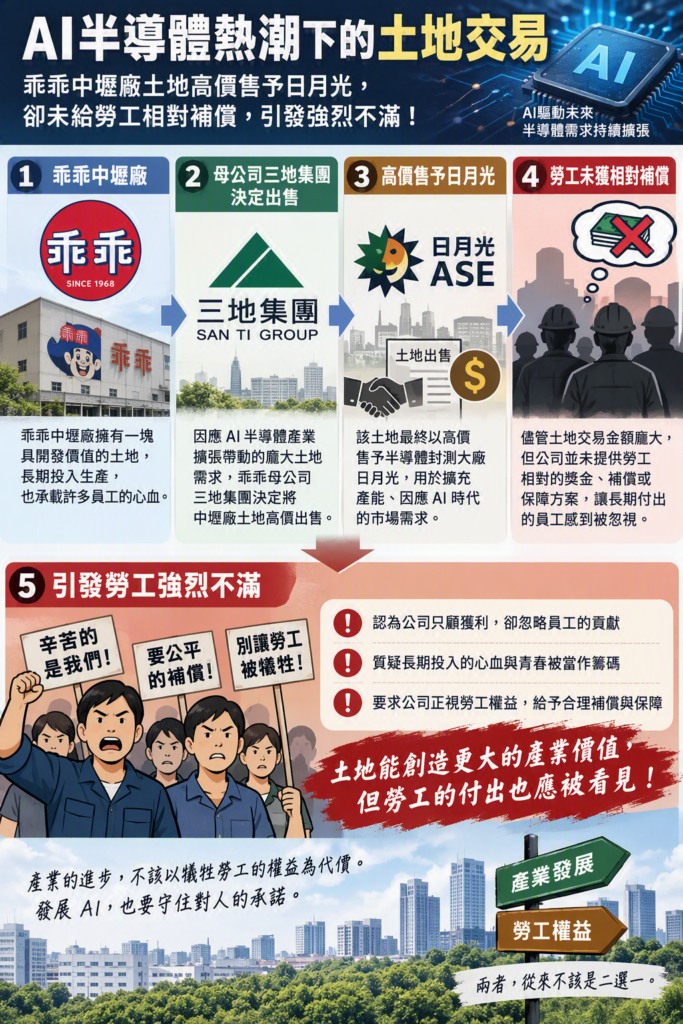
What happened?
Kuai Kuai (乖乖) has a factory in Zhongli, Taiwan. The factory sits on a piece of land that has become much more valuable because Taiwan’s AI and semiconductor industry is expanding rapidly.
The parent company, San Ti Group (三地集團), decided to sell the factory land to ASE (日月光), one of Taiwan’s largest semiconductor companies.
Why was the land valuable?
Because many technology and semiconductor companies need more space to build factories and expand production for AI-related products and chips.
As demand for land increased, the value of the Zhongli factory site reportedly rose significantly.
Why are workers upset?
Some workers believe:
- The company made a large profit from selling the land.
- Employees spent many years helping build the business.
- Workers were not given meaningful bonuses, compensation, or special benefits related to the land sale.
- The company’s decision seemed to reward shareholders and owners more than employees.
What are the workers saying?
In simple terms:
“We helped create the company’s success. If the company earns a lot of money from selling this land, workers should also receive fair recognition and compensation.”
What is the debate?
The issue is not really about AI itself.
The debate is:
Should employees share in the benefits when a company earns a huge windfall profit from an asset sale?
There are two viewpoints:
Company side
- The land belongs to the company.
- Management has the legal right to sell it.
- The money may be needed for business planning and investment.
Workers’ side
- Employees contributed to the company’s growth for many years.
- A major sale generated substantial value.
- Workers deserve a share of the gains or additional protection.
One-sentence summary
A valuable factory site was sold to a semiconductor company during Taiwan’s AI boom, and some workers are angry because they feel the company profited greatly from the sale while employees received little or no additional compensation.