
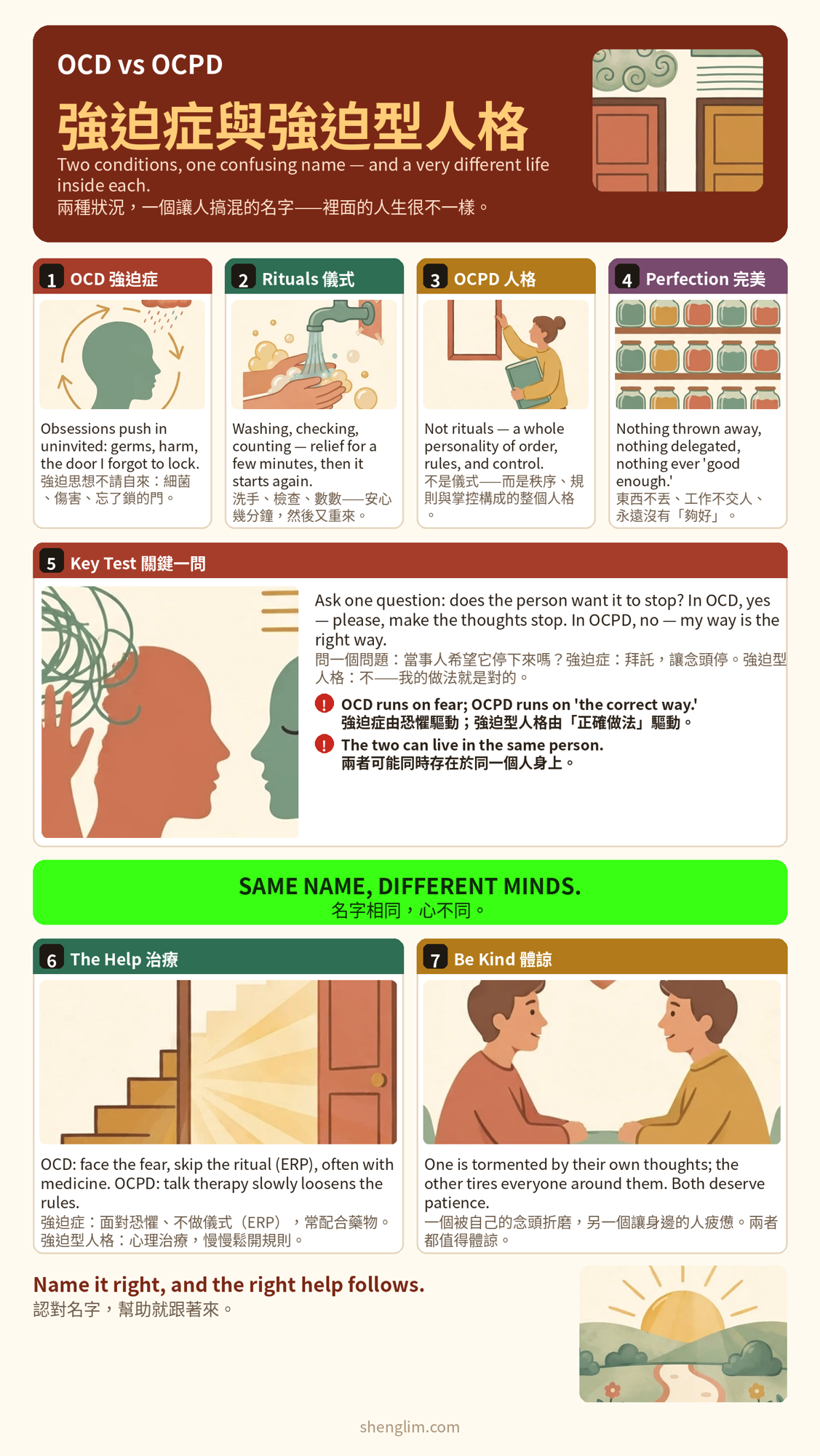
“He’s so OCD” — people say it when a desk is too tidy. But OCD and OCPD are two different conditions that happen to share a name.
「他好強迫症喔」——桌面太整齊時,人們常這樣說。但強迫症(OCD)與強迫型人格(OCPD)只是名字相像,其實是兩種不同的狀況。
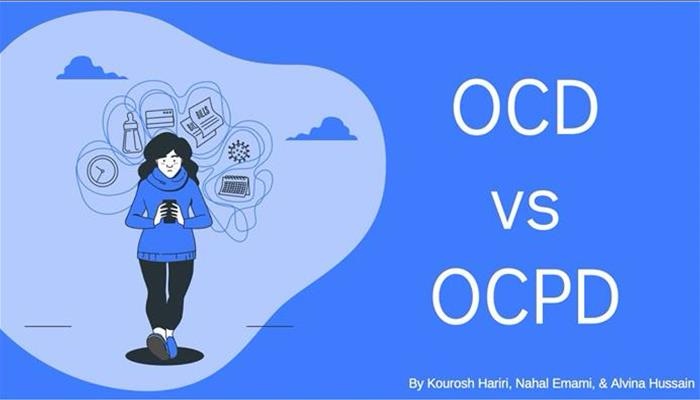
OCD: The Unwanted Guest
強迫症:不速之客
OCD brings obsessions — thoughts that push in uninvited: Did I lock the door? Are my hands dirty? What if I hurt someone I love?
強迫症帶來「強迫思想」——不請自來的念頭:門鎖了嗎?手乾淨嗎?萬一我傷害了所愛的人怎麼辦?
To quiet the fear, the person repeats compulsions: washing, checking, counting. The relief lasts a few minutes, then the thought comes back.
為了壓下恐懼,患者會反覆做「強迫行為」:洗手、檢查、數數。安心只維持幾分鐘,念頭又回來了。
The cruel part: most people with OCD know their fears are too much. The thoughts feel foreign and unwanted — doctors call this ego-dystonic.
最折磨人的是:多數強迫症患者知道自己的恐懼過頭了。這些念頭感覺陌生、不受歡迎——醫學上稱為「自我不協調」(ego-dystonic)。
OCPD: The Strict Manager
強迫型人格:嚴格的經理
OCPD is not a set of rituals. It is a personality pattern — order, perfection, and control in every part of life, starting by early adulthood.
強迫型人格不是一套儀式,而是一種人格模式:秩序、完美與掌控,遍及生活的每個角落,從成年早期就開始。
Lists, rules, and schedules matter so much that the point of the activity gets lost. Work comes before rest and friends. Nothing is thrown away — “I might need it someday.”
清單、規則和行程重要到忘了活動本身的目的。工作排在休息和朋友之前。東西從不丟棄——「以後可能用得到」。
And here is the mirror image of OCD: the person with OCPD usually feels their way is simply right. The traits fit who they are — ego-syntonic — and the suffering often falls on the people around them.
這正是強迫症的鏡像:強迫型人格的人通常覺得自己的做法就是對的。這些特質與自我一致——「自我協調」(ego-syntonic)——受苦的往往是身邊的人。
The Key Difference
關鍵差別
Ask one question: does the behavior feel like a problem to the person doing it? In OCD, yes — the person wants the thoughts to stop. In OCPD, usually no — the person wants everyone else to do things properly.
問一個問題就好:當事人覺得自己的行為是問題嗎?強迫症:是——他希望念頭停下來。強迫型人格:通常不是——他希望別人把事情做對。
OCD is driven by anxiety, by fear that something bad will happen. OCPD is driven by belief: there is a correct way to do things, and it must be followed.
強迫症由焦慮驅動,害怕壞事發生。強迫型人格由信念驅動:事情有正確的做法,而且必須照做。
The two can also live in the same person. OCPD is one of the most common personality disorders, and it often appears alongside OCD.
兩者也可能同時存在於同一個人身上。強迫型人格是最常見的人格障礙之一,也常與強迫症一起出現。
Different Problems, Different Help
問題不同,解法不同
OCD has a specific, effective therapy: exposure and response prevention (ERP) — facing the feared thought step by step, without doing the ritual — often helped by SSRI medicine.
強迫症有專門且有效的療法:「暴露與反應預防」(ERP)——一步步面對恐懼的念頭,卻不做儀式——常配合 SSRI 類藥物。
OCPD has no single medicine. Talk therapy works slowly on the rigid beliefs themselves: learning that “good enough” can be good, and that control always has a price.
強迫型人格沒有專門的藥物。心理治療慢慢處理那些僵化的信念本身:學會「夠好」也可以很好,也看見掌控必有代價。
One Line to Remember
一句話記住
OCD says: “I know this sounds crazy, but I can’t stop.” OCPD says: “I’m not the problem — everyone else is.”
強迫症說:「我知道這聽起來很瘋狂,但我停不下來。」強迫型人格說:「我不是問題——其他人才是。」
One is fighting thoughts they never wanted. The other is defending a way of life they believe is right.
一個在對抗自己不想要的念頭;另一個在捍衛自己深信正確的生活方式。
Good to Know
須知
A tidy desk is not a diagnosis. Both conditions are diagnosed by a professional using DSM-5 criteria — not by habits, and not by jokes.
桌面整齊不是診斷。這兩種狀況都由專業人員依 DSM-5 標準診斷——不靠習慣,更不靠玩笑。
This is educational reading, not medical advice. If the thoughts or the rules are running your life, a psychiatrist or psychologist is the right next step.
本文是知識分享,不是醫療建議。如果念頭或規則正在主宰你的生活,下一步是找精神科醫師或心理師。
The Weight of Perfection: Understanding OCPD and Depression 完美的重擔:理解強迫型人格障礙與憂鬱症
Introduction / 引言:
Living with Obsessive-Compulsive Personality Disorder (OCPD) is often misunderstood as simply being an extreme perfectionist. 與強迫型人格障礙(OCPD)共存,往往被誤解為單純的極端完美主義。
However, when the relentless pursuit of flawlessness collides with severe emotional burnout, it can easily spiral into a deep depression. 然而,當對完美無瑕的無情追求與嚴重的情緒倦怠碰撞時,很容易就會陷入深沉的憂鬱漩渦。
The following conversation explores this silent struggle, shedding light on how rigid standards can impact mental health and how we can better support those going through it. 以下的對話探討了這種無聲的掙扎,闡述了僵化的標準如何影響心理健康,以及我們該如何更好地支持正在經歷這一切的人。
Conversation / 對話
Sarah: Have you noticed how exhausted Emily has been looking lately?Sarah: 你最近有沒有注意到艾蜜莉看起來有多疲憊?
Mark: Yeah, I’m really worried about her. She’s been working late every single night.Mark: 是的,我真的很擔心她。她每天晚上都在加班。
Sarah: It’s not just the work hours. It’s her intense obsession with making everything absolutely perfect.Sarah: 不僅僅是工作時間長。而是她對把一切都做到絕對完美的強烈執念。
Mark: You mean her OCPD? It seems like it’s taking a heavier toll on her mind these days.Mark: 你是說她的強迫型人格障礙(OCPD)嗎?最近這似乎對她的精神造成了更沉重的打擊。
Sarah: Exactly. With OCPD, she feels an overwhelming need for control and gets stuck on the smallest details.Sarah: 沒錯。因為患有 OCPD,她對控制有著壓倒性的需求,並且總是糾結於最微小的細節。
Mark: And she refuses to delegate anything because she firmly believes no one else can do it “right.” Mark: 而且她拒絕把任何事情交給別人,因為她堅信除了她沒人能「正確」地完成。
Sarah: That rigid mindset is driving her straight into severe depression. The burnout she is experiencing is entirely real.Sarah: 這種僵化的思維正把她直接推向嚴重的憂鬱。她所經歷的精疲力竭是完全真實的。
Mark: It breaks my heart. She told me she feels like a constant failure, even though she works harder than anyone we know.Mark: 看到她這樣我很難過。她告訴我她覺得自己總是個失敗者,儘管她比我們認識的任何人都努力。
Sarah: That’s the tragedy of combining OCPD with depression. Her impossible standards guarantee she will always feel inadequate.Sarah: 這就是 OCPD 結合憂鬱症的悲劇之處。她那不可能達到的標準注定了她永遠會覺得自己不夠好。
Mark: She’s incredibly hard on herself. The sadness is so heavy that she doesn’t even have the energy to enjoy her hobbies anymore.Mark: 她對自己極度苛刻。那種悲傷如此沉重,以至於她現在甚至沒有精力去享受她的愛好了。
Sarah: I gently suggested she talk to her therapist about adjusting her treatment plan or focusing on cognitive behavioral therapy for her rigidity.Sarah: 我委婉地建議她和心理醫生談談,調整一下治療方案,或者針對她的刻板思維做一些認知行為療法。
Mark: How did she react? Usually, she hates the idea of not being able to manage everything perfectly on her own.Mark: 她怎麼反應的?通常情況下,她非常討厭那種無法靠自己完美掌控一切的感覺。
Sarah: She was defensive at first, but I think the sheer exhaustion from the depression is finally making her realize she needs external help.Sarah: 她起初有防禦心理,但我認為憂鬱帶來的極度疲憊最終讓她意識到她需要外界的幫助。
Mark: We need to make sure we offer our support without accidentally triggering her need to be the perfect friend.Mark: 我們必須確保在提供支持的同時,不會意外觸發她想做一個完美朋友的執念。
Sarah: Right. Let’s just consistently remind her that we care about who she is, not her productivity or flawless results.Sarah: 對。我們就不斷地提醒她,我們在乎的是她這個人,而不是她的生產力或完美無瑕的成果。
Conclusion / 結語:
Supporting someone navigating both OCPD and depression requires immense patience, understanding, and a gentle approach. 支持同時在 OCPD 和憂鬱症中掙扎的人,需要極大的耐心、理解和溫和的態度。
It is crucial to remind them that their worth is not measured by their productivity, their achievements, or their ability to control every outcome. 至關重要的是要提醒他們,他們的價值並不是由他們的生產力、成就,或是控制每個結果的能力來衡量的。
If you or someone you care about is facing similar challenges, remember that seeking professional help is a powerful sign of strength, not a failure. 如果您或您關心的人正面臨類似的挑戰,請記住,尋求專業幫助是強大力量的展現,而不是失敗。